
Civil Disobedience plus
Blockade, Occupation, Climate Camp: The action days in Hamburg show that the climate movement is present and capable of action. The alliance "Ende Gelände" for the first time considers vandalism as fundamentally legitimate and thereby changes the debate about forms of action.
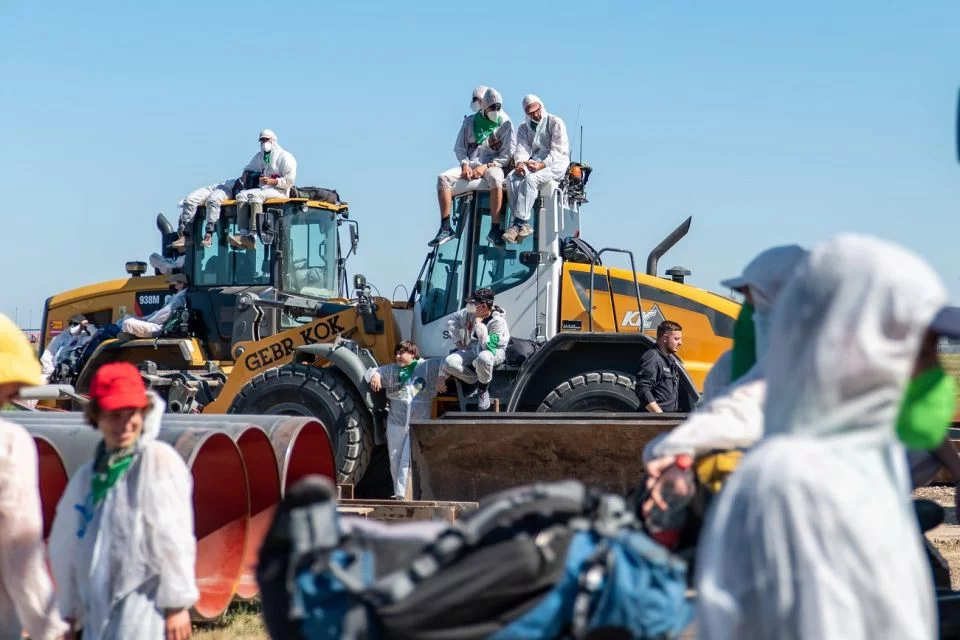
By five o'clock in the morning on Friday, there is already a lot of activity at the "System Change Camp" in Hamburg-Altona. People are leaving their tents, heading in different directions from the camp and meeting at various locations in the city to travel to the construction site of the liquefied natural gas terminal in Wilhelmshaven by bus.The strategy works. The police are unprepared; instead, they had positioned themselves at a similar construction site in Stade. On the scene, everything happens very quickly: barely stepping out of the bus, the activists in white suits form into a column, the construction site is occupied – and machines are damaged.
Activists from the "green finger" of the Climate Justice Alliance "Ende Gelände" distribute themselves on excavators, machinery, and pipeline pipes. The workers shut off their machines, some confused, others happy for a break. Some take out their lunch, sit in the shade, and play music.
On the occupied construction site, the seven-ton pipes are being bent and stored, making it an important focal point of the gas infrastructure in Germany.
The new LNG terminal in Wilhelmshaven is one of about a dozen liquefied natural gas transfer points that the federal government wants to use to achieve independence from Russian gas. "Ende Gelände" criticizes that an extremely climate-damaging fossil infrastructure is being expanded here. Moreover, the alliance also wants to scandalize the accompanying neocolonialism.
Two years ago, "Ende Gelände" expanded its only previous goal – the coal exit – and occupied, in addition to lignite plants in the Rhineland, a gas power plant and the construction site of the natural gas pipeline Zeelink. Last year, the alliance blocked an LNG terminal construction site for the first time in Brunsbüttel.
This year, the issue of liquefied natural gas has become even more important due to the invasion of Ukraine. "Ende Gelände" takes a very clear stance on this: "That natural gas is not climate-damaging is a brazen lie," says spokeswoman Sina Reisch.
Criticisms are not only directed at environmentally harmful extraction methods such as fracking. Above all in countries of the global south, the extraction of natural gas often goes hand in hand with human rights violations. The climate burden is significant due to methane emissions, environmental organizations point to the incomplete recording of emissions.
In Hamburg, the action continues on Saturday. As many as 2,000 people take part in a demonstration at Altona station early in the morning. There, they divide into a pink, purple, and golden "finger," as the different trains are called, which move through the city under massive police escort.
The fingers occupy several sections of tracks and access roads to the Hamburg port, which stands for the activists for the connection between the fossil industry in Germany and colonial exploitation in the global south.
Many international activists are also on site, drawing attention to the neocolonial and racist exploitation associated with the climate crisis through speeches and events at the camp. "Fight neocolonialism – block the system" is written on the front transparency of the pink finger.
The police respond with repression. Many activists, medics, as well as journalists and parliamentary observers later report on police violence. When the purple finger blocks the Kattwyck Hub Bridge, the police use water cannons, batons, and pepper spray.
The Hamburg police claim to have been attacked with pepper spray during the demonstration, but cannot prove it. Media reports suggest that police officers sprayed the irritant gas against the wind and were hit by their own pepper spray.
In a statement, the Hamburg police "rejects all fake news," but acknowledges that "the aerosol cloud also has effects on emergency forces in dynamic situations."
No longer just a blockade
In the action of the green finger on Friday in Wilhelmshaven, the activists hang banners on machines after storming the construction site. Then they make themselves comfortable in and under the gas pipelines.
Suddenly, a clinking sound can be heard as spotlights from equipment are deliberately destroyed with stones. The tires of a truck and covers of gas pipelines are also damaged.
Civil disobedience is thus for the first time part of an action by the "Ende Gelände" coalition, which has held the decisive sentence in its annual action consensus this year that "we can also shut down climate-damaging infrastructure beyond our presence."
The alliance has thus achieved a shift in discourse in the discussion about legitimate forms of action, regardless of how much has ultimately been damaged in the long term and how operations are actually halted.
The confrontation with vandalism and sabotage has become more intense since the peak of the climate movement in 2019, as the impact of increasingly smaller demonstrations and actions has been increasingly questioned.
It was a long process that now leads to the actual inclusion of sabotage in the action consensus, with many debates and internal conflicts in the past years. What does it mean to be a "nonviolent" movement? Does it not legitimize the violence that fossil companies exert by fueling the climate crisis and exploiting the global south, including violence against objects?
"Ende Gelände" is not entirely unified in opinion on this issue yet, which is also hardly possible in a grassroots movement. The action consensus applies to everyone, but this does not mean that everyone has to do everything; the actions merely need to stay within the framework of the consensus.
Also this year, many were not willing to go beyond blocking with their bodies. Others were ready to support sabotage in the background, but not to damage anything themselves.
The debate about forms of action has now taken a decisive step forward. The fact that a major actor in the climate movement considers sabotage fundamentally legitimate has changed something. This is what a part of the climate movement wants to build on in the next few years.
40 political groups, one camp
An important element of this year's action days is the "System Change Camp," where the activists have been camping during the week.
It is the first major climate camp to emerge from acts of civil disobedience since the COVID-19 pandemic. For many, it is a place to gather, exchange, and empower. Around 40 political groups are involved, such as Fridays for Future or Extinction Rebellion, but also the communist "Ums Ganze" alliance or Abya Yala Anticolonial.
An activist explains: "This week not only fossil and colonial infrastructure will be blocked, the movement has the chance to come closer together, to take a step further, and to dare to live an utopia in the form of a climate camp."
On Monday, the camp is already much emptier. In a dismantling plenum, tasks are distributed, and slowly the camp is turning back into the Altonaer Volkspark. At the infopoint, on a large board, there are newspaper articles about the actions of the last few days. Many here form an impression of the public impact of the actions, showing each other their favorite articles.
The activists are satisfied. "We have shown this week: The climate movement has full power," says Luka Scott, spokesperson for Ende-Gelände. "Who invests in fossil infrastructure in 2022 must reckon with our resistance."
The next actions of civil disobedience plus vandalism will definitely come. "Ende Gelände" has presented this week.