
Sol and Luna, the two jaguar cubs rescued from wildlife trafficking in Peru
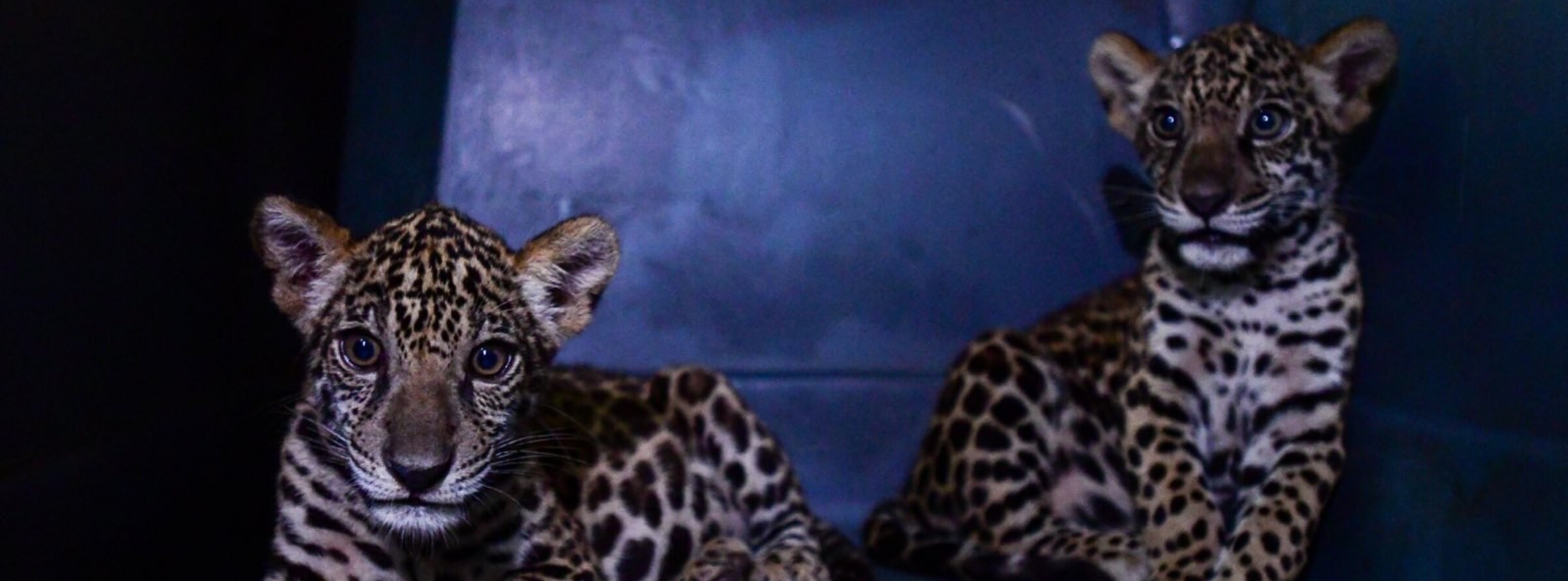
Sol and Luna, the two jaguar cubs rescued from wildlife trafficking in Peru
On February 28, Peruvian police seized two jaguar cubs on the Federico Basadre highway in the central-eastern Amazon of the South American country.Luna bites Sol's right ear, wanting to play. This one, still intimidated by the presence of strangers, just moves away and enters its cage. The two jaguar cubs, just over two and a half months old, are learning to recognize their caregivers, who have named the male "Sol" and the female "Luna" because they say "their personalities are opposite and complementary at the same time." Both animals were rescued on February 28 while being transported on the Federico Basadre highway, in the Ucayali region, in the central-eastern Amazon of Peru, under poor sanitary conditions.
Read more | Images from camera traps and sounds reveal the best-kept secrets of five small wild cats of Latin America
Jaguars (Panthera onca) are carnivorous felines of the Amazon that are nearly threatened, according to the IUCN Red List of Threatened Species. Sol and Luna were found in wooden boxes with signs of abuse and malnutrition by the police and staff of the Regional Government of Ucayali's Forest and Wildlife Management.
“Their captors hid them in fruit boxes to avoid detection. We still don't know their final destination, but those involved have been reported for the crime of wildlife trafficking,” detailed Franz Tang Jara, the Forest and Wildlife Management Manager of the Regional Government of Ucayali.
The cubs are currently in the regional quarantine, where they are being fed, their wounds have been treated, and they are beginning to interact with each other. At the time this article was closed, the male weighed 9 kilograms and the female, 10 kilograms. Tang Jara specified that since they were separated from their mother at a very young age, they did not learn to hunt and do not know how to survive on their own in their natural environment, therefore, it is impossible for them to return to the jungle.
The cubs will not be able to return to nature as they would die; they will live in captivity for the rest of their lives. The wildlife trade affects the biological cycle of these animals by taking them away from their natural habitat, noted the manager.
In addition to the two jaguar cubs, the Regional Government of Ucayali rescued an adult jaguarundi (Herpailurus yagouaroundi) on March 14, found in a warehouse at the port of Pucallpa. The feline was also taken to the quarantine and was released four days later, at the height of kilometer 30 of the Federico Basadre Highway, after a medical evaluation.
The puppy Luna weighs 10 kilograms. She is larger than the male, as is usual for her species at this age. Photo: Regional Government of Ucayali
Additionally, in the Ucayali region alone, in 2024, the seizure of 450 live animals was registered, mainly birds and mammals; 181 kilograms of wild meats and fresh and salted reptile eggs, and 560 parts of dried animals in shells, handicrafts, and other objects.
Read more | From Extinction to Life: The Birth of Chicks in Argentina, Venezuela, and Brazil Gives Hope to Bird Conservation | Photo Essay
So far this year, they have already registered the rescue of 34 live animals, with Sol and Luna now part of the statistics.
Due to being separated from their mother at a very young age, Sol and Luna will always live in captivity, experts explain. Photo: Regional Government of Ucayali
The jaguar is the third most trafficked feline in the world after the tiger (Panthera tigris), which is found only in the Asian continent, and the lion (Panthera leo), in Africa. In Peru, this crime is punished with three to five years in prison if someone acquires, sells, transports, stores, or exports any wild species for pets or as game meat and its parts: skulls, teeth, skins, leathers. However, if the trafficker is identified as part of a criminal organization, the sentences reach between 11 and 20 years.
Despite the high penalties, this has not stopped the trafficking in recent years. According to a 2021 study by the Convention on International Trade in Endangered Species of Wild Fauna and Flora (Cites), Peru is the country that sent the most parts of jaguars, with 24% of the statistics, followed by Bolivia (14.1%). Additionally, it considers the United States as the most frequent destination for this traffic, with 76.3%, followed by Germany (5.3%) and China (4%).
Sol, the male cub, is more reserved and cautious when interacting with his caregivers. Photo: Regional Government of Ucayali.
However, there is a significant underreporting of these figures. "Only 10% or 15% of jaguar species trafficking cases in the country are reported. This is due to the vastness of our Amazon and the difficulty of communication. Moreover, people do not know how or where to report a trafficking case," explained Pamela Pastor, the regional analyst for the Combating Wildlife Trafficking of Panthera, to Mongabay Latam.
The expert explains that the causes of the jaguar trade have changed in the last few decades. For example, between the 1940s and 1970s, hunting was mainly carried out for the commercialization of its skin, but since 1975 this has changed and in recent years the death of jaguars is related to a poor perception of these animals.
"In rural communities, there is a belief that the jaguar is dangerous, that it eats chickens, cows, and can attack humans, which is one of the main reasons for its hunting," Pastor said. "But, in addition, there is a demand for traditional medicine to use its parts. One of the cases that have not yet been studied is the ayahuasca ceremonies and how the supposed shamans recommend using parts of the jaguar," he explained.
Due to the rainy season and because both cubs still do not know how to climb trees, they continue to be under the care of the quarantine staff. Photo: Regional Government of Ucayali
At the Belén market, the main distribution center of the Loreto region, illegal wildlife species are traded. Photo: Geraldine Santos
Regarding live animals, they are mainly used as "pets," but only when they are puppies because they have not yet developed the hunting instinct, as is the case with Sol and Luna. Peru has the second largest population of jaguars with more than 22,200 individuals, after Brazil. The global jaguar population is on a negative trend.
A jaguar cub consumes a kilogram of meat daily, while an adult eats between 4 and 6 kilograms. As they grow, they need more space to move around and their hunting instincts start to emerge, but without being in a free area, it is impossible for them to learn to capture other wild animals.
"There is a serious problem in Peru because all the rescue centers are private and are already full, there are few public spaces. It is a challenge, especially when rescuing felines due to the cost of food, medicine, and care," said Pamela Pastor.
The two jaguar cubs are cared for by the staff of the Ucayali Forest and Wildlife Management until they are transferred to the zoo in the area. Photo: Regional Government of Ucayali
In Ucayali, the Pucallpa Natural Park, administered by the Regional Government of Ucayali, is where animals rescued from the wildlife trade are housed, but after the pandemic, some species were lost. To date, there are 47 animals among birds, reptiles, and mammals.
Read more | When the water returned to an Ecuadorian páramo, so did the deer and the pumas
"The appropriate spaces for these animals are at the Parque de las Leyendas and the Huachipa Zoo, but it is difficult for them to accept these cubs because the space is occupied. Many times, they only accept a new animal when another dies. That is, if there is only one available space. In Peru, there is a lack of public places where rescued felines can be," noted the Panthera expert.
Sol y Luna will remain in Ucayali; an environment has been adapted for both at the facilities of the Pucallpa Natural Park, confirmed the Regional Government of Ucayali by the time this note was closed. They will not be transferred to another region as was initially proposed. Meanwhile, due to the rainy season and because both cubs have not yet learned to climb trees, they continue to be cared for by the staff of the quarantine area.
Main Image: The two jaguar cubs will be transferred to the Pucallpa Natural Park after being rescued from wildlife traffickers. Photo: Regional Government of Ucayali