
With Scent and Heart: The Story of the Trainer and the "Tiger Dogs" That Track Jaguars to Protect
Them
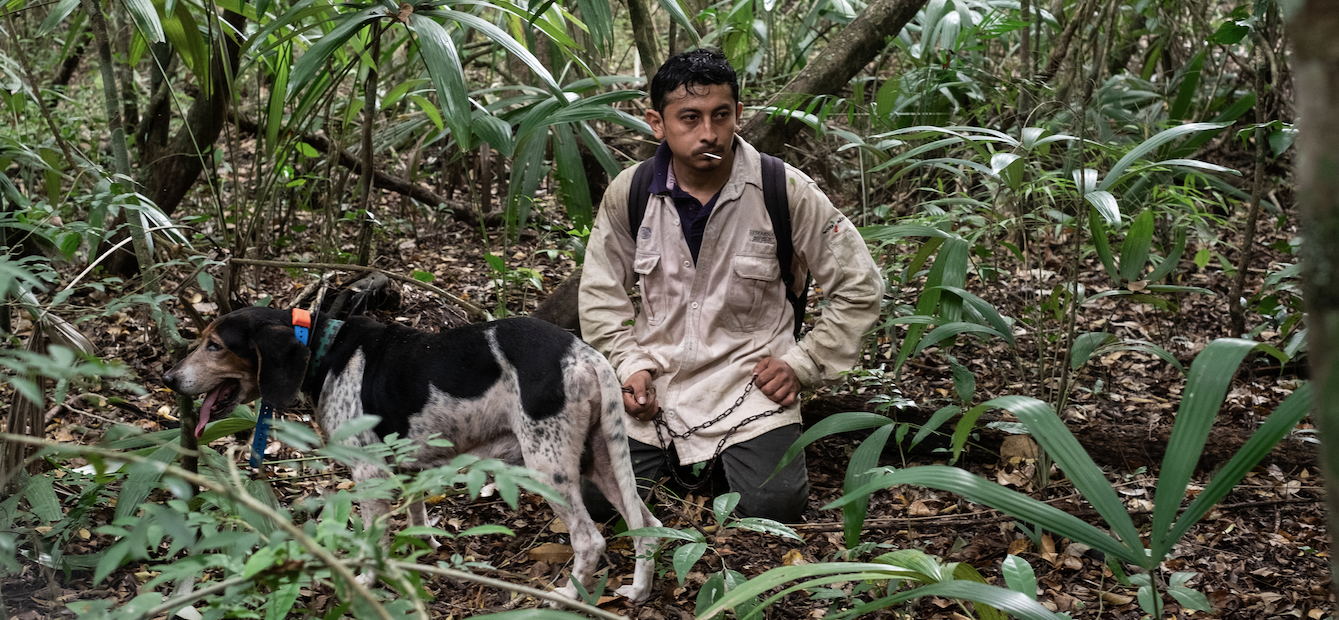
Christian Coyoc Romero, a former hunter turned conservationist, works on the protection of jaguars in the Yucatan Peninsula, southeastern Mexico.
As a child, he loved to daydream in the jungle. Christian Coyoc Romero grew up beside the mountain, in Laguna Om, a ejido located in Quintana Roo, in the southeastern part of Mexico. At 10 years old, he would grab a small backpack, put a glass, some water, a bag of pozole —a traditional stew with corn, meat, and chili— and a small machete in it. With his provisions on his back, he would make his way through the tall trees, where his imagination transported him on an adventure through the Amazon. “Back then, I was a bit foolish to go into the jungle, but I would wander around there, on the edges of the village. I imagined a lot. I said that one day I would make a trip to the other side, to do something important,” says the 30-year-old young man. Like several members of his family, he was a hunter. Today, he has become a trainer of specialized dogs for the search of jaguars for their research and conservation.The dogs he has trained have managed to track down about 12 felids to place satellite tracking collars on them and return them to nature for monitoring and study.
For the past seven years, Christian Coyoc Romero has been working under the direction of Dr. Gerardo Ceballos, a researcher at the Laboratory of Ecology and Conservation of Wild Fauna of the Institute of Ecology of the National Autonomous University of Mexico (UNAM). This is a unique team in the country—and probably in Latin America and the world—that uses dogs as a non-invasive method to capture felines for scientific purposes. For nearly three decades, the specialists, in collaboration with local communities such as Ejido Laguna Om, have explored the Yucatan Peninsula to study the species in depth and develop strategies to prevent its extinction.
The real adventures of Coyoc Romero in the jungle were joined by Zafira. She was a home-raised puppy. The young man got her used to sleeping comfortably and warmly with her blanket and a small pillow. Among all her siblings in the litter, the young man fell in love with her. It was her spots. He says that in one of them, he painted a pair of dots that looked like eyes.
Therefore, she is my favorite, and here she is now, working, he adds proudly. "I feel like a father saying, 'That's my daughter.' She's about to turn three," says the trainer.
Their days together begin early in the morning. Zafira is part of a specialized pack, where she works with other dogs like Melissa, Tranqui, Guapeche, and Franco. Alongside don Francisco “Pancho” Zavala Castillo, an 83-year-old expert hunter, they traverse the paths of the ejido in search of traces that indicate the passage of a jaguar. As former hunters and residents of the area, they know where the elusive felines tend to move and are the ones who guide the specialists to their encounter, usually up in the tall trees of the jungle. There, the jaguar is sedated and lowered to the ground with ropes for the collection of samples, morphometric measurements, weighing, and fitting of a collar.
In Mongabay Latam, we spoke with Christian Coyoc Romero about the learnings and complexities of his community work for the conservation of the feline in one of the most important sites for this species in Mexico.
— How did your interest in dog training begin?
—I have always liked animals. I liked the mountains, going into the jungle, and I have always had a love for dogs. Dog I found on the street, let's go! “You've brought another dog!” my boss, my mother, who was the one who made a fuss, would say.
At a certain time, my family was dedicated to hunting. My grandfather was a hunter, and that's what attracted me to this. I was a hunter. The village was small, everyone knew each other, and 15 years ago, I went hunting every day with friends from the colony. All of that was very attractive to me. Unfortunately, due to family situations, I couldn't finish my studies. By a twist of fate, I went to work in the countryside, in the north of the country for a while.
When I came back, I dedicated myself to working on a cattle ranch. There, by coincidence, they told me that in the Laboratory project, they were looking for a worker who knew about dogs. "Go ahead, go ahead, I'll take the shot," I said. "That's what I like, you're a good fit. Don't be scared, huh?" Don Pancho Zavala told me.
—Did he decide to give up hunting and focus on conservation?
—Yes. I arrived, I was hired, I liked it, and I say, “What am I doing? I am ending it all. What will be left ahead? If only I do this every day, what will 500 people, 1000 people do every day? How many animals will we lose?” Imagining how many animals might remain in the forest.
I say: "I am making a serious mistake." And now I feel that it's not much, but I believe it's a grain of sand, that I am contributing to conservation. Mainly, to this great cat, the jaguar. An emblematic feline for us on the peninsula, especially for the Maya culture, from which I am descended. It cannot be possible that we have reached such a degree of hunting it, of almost exterminating this symbol for us.
Guapeche and Tranqui, dogs of the specialized pack. Photo: Isabel Mateos Hinojosa
What does your job as a dog trainer consist of?
My job as a dog trainer involves cataloging a dog. For that, first, we take offspring from a guide dog that is good. We crossbreed it with another guide dog that has good genetics, a strong dog. We try to make the dogs strong, with a good sense of smell and endurance because we need a dog with a lot of sense of smell for this type of work.
In the past, when hunting was allowed, what was done to train a tiger dog —that's what they are called— was to kill a jaguar. When the dogs encountered the animal in a chase and managed to corner it —that is when the jaguar is up in a tree—, the feline was severely injured so that the dogs would start to fight with it. The next time, the dogs already had an idea of what the smell was.
What we do now is different. We train the dogs with feline scents to try to attract them and give them an idea of what the smell of a jaguar is. We do not use aggressive methods because everything has changed. Instead of subtracting, we try to add a grain of sand to conservation.
Part of the community team responsible for training the tiger dogs in Laguna Om. Photo: Isabel Mateos Hinojosa
—What are the scents they use?
—We use the smells, mostly from domestic cats. We impregnate old fabrics or clothes and try to get the dogs familiar with these smells. There are certain aromas that resemble, to put it colloquially, the pest of the animal, and that is what we try to teach them, to learn this method. To put it that way, it's an artificial bait. It is the most beneficial, the healthiest.
—What is a day of field work in the jungle like?
—we have to leave first. We take a guide dog that, in this case, is Melissa, one of the best dogs we have in the pack. We arrive with Don Francisco Zavala and, since a day before, we start looking for places. Since we already have an idea of what the area is like and where the animal might move, we go straight there and start looking for traces. These are scratching marks, excrement, and droppings in the areas we know. Areas where there are potential prey for the animal —like the capybara—are where we go to track.
When we arrive with the dog, it no longer chases any other animal but the jaguar, because it already has an awareness of the scent and knows what its job is. No other animal can deceive it, and it has no interest in them.
Then, we arrive and, when the dog becomes frenetic, everything changes. At first, the dog arrives calmly, but as it starts to sniff and track, its frenzy increases. That's when we realize there's a trail, that an animal might have passed by.
Huele, feel the trail, confirm, and return with us because the pack is not complete. That's where we are sure we can let the others go. It has already been confirmed that we have a chase. We return with the entire team [of scientists] who are already waiting for us on the way to do the rest of the work.
Melissa, the leader dog of the specialized pack, alongside veterinarian Berenice Portillo and Christian Coyoc Romero. Photo: Isabel Mateos Hinojosa
Melissa is the leader. Here, at the camp, she is a very calm, very obedient, and very intelligent dog. Out in the field, she transforms into something else. She goes wild, it's a frenzy. She is a dog with a strong sense of smell, a dog that is very tenacious, very resilient: even if she is tired, she tries to keep going. Even if she reaches the end, she reaches it. That is her personality: she is punctual, tenacious, and a fighter.