
There is a floating wall in the middle of the ocean: It is creating an extremely strange effect
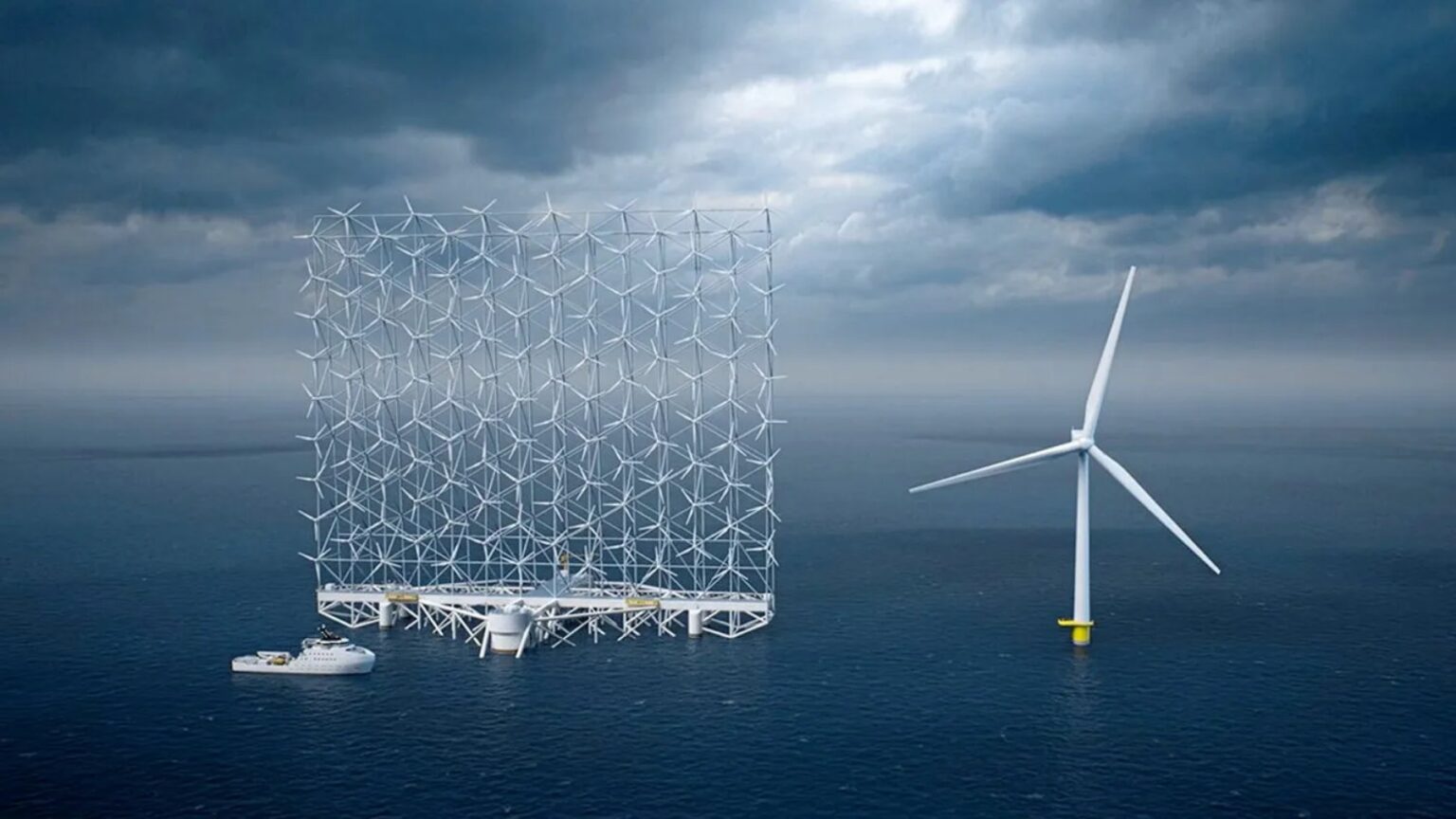
A futuristic energy design, through a floating wall, is creating a sensation due to its strange effect and construction.
A unique energy concept, with a floating wallUtilizing clean energy sources is what we all aim for, and the Earth offers us abundant renewable resources to achieve this. One of them is through wind, but not any turbine; there is a new technology that utilizes intelligence and ingenuity.
Yes, we are talking about wind energy, but in a different form that aims to be quieter, with greater efficiency, and causing an effect never seen before.
It will be a gigantic floating offshore wind farm composed of hundreds of small turbines grouped together, rather than a single giant turbine. This is the vision of the company Wind Catching Systems (WCS). The figures for this first prototype, whose completion is scheduled for 2029, are truly ambitious, with 40 small 1 MW wind turbines installed in a spectacular floating structure.
The unique and elevated design of the wind turbine groups resembles a "floating wind wall." WCS has initiated the process to obtain a license for a demonstration project off the coast of Oygarden, an island municipality in the southwest of Norway.
But its extraordinary effect is the power it generates, as it could capture 2.5 times more energy per square meter of wind flow than a traditional three-blade turbine design. As surprising as micro-wind energy, a solution that Mexico is not yet familiar with: free and infinite energy at home.
Although it has obtained certification for a 40 MW model, WCS anticipates units with a capacity of up to 126 MW. According to the statement, this would generate five times the electricity of an independent 15 MW turbine system under North Sea conditions, and even more in certain areas with strong winds worldwide.
Advantages of this technology over traditional wind turbines
The concept, which already has a preliminary analysis by DNV (Approval in Principle), proposes the following advantages over conventional wind energy:
Standardization: Small-scale wind turbines designed to be manufactured anywhere in the world with minimal investment. Moreover, avoiding the scaling of turbines allows for automation and innovation in manufacturing processes, while promoting economies of scale.
Scalability: The concept scales by increasing the size of the structure, but the turbine technology and the manufacturing process remain unchanged.
Efficient use of space: The electricity production per unit of floating area is maximized, optimizing the use of the available area.
Innovative operation and maintenance: The structure includes a lifting platform that allows access and extraction of each turbine without the need for large cranes or to tow the platform to the port. Additionally, the shutdown of one or two turbines is not as critical for energy generation, and the availability of spare parts is simplified.
Designed for the fierce winds of the North European seas, the Windcatcher promises to reduce the levelized cost of energy for floating wind turbines and would be connected to an integrated substation on a "mother ship" that would connect all units and export energy to the mainland.
The Windcatcher is designed to withstand the harsh conditions of open sea. It is a modular system, scalable or reducible according to energy needs. Each unit is connected to a central substation, which in turn transmits electricity to the power grid.
A physical replica of the Windcatcher was tested in the Stadt, Norway, Trailer Tank to determine its performance under various wave conditions. A new technology for the future like this bladeless wind turbine and free energy at home.
With this innovation of the floating wall in the middle of the ocean with great energy power, it is reported that the Windcatcher also has the potential to produce green hydrogen. This versatile fuel can be used in various applications, from transportation to industry.